
Investing in Palladium in 2026: All About Palladium Prices and Investment Options
The 2020s have brought unprecedented changes to the world. These changes are exercising heavy influence in financial markets.
Considering these new challenges, portfolio managers must seek assets that are able to shield their investments from shocks in geopolitics and industries.
The platinum group of metals are among those assets that attract a lot of attention from wealth managers across the world. Among these choices, one has become a topic of debate, with many asking: is palladium a good investment?
The answer is not as simple as a yes or no. It largely depends on macroeconomics and timing.
For early adopters, palladium as an investment yielded astronomical returns. But today, the asset is marked by extreme volatility and uncertainty over future usage.
If you’re interested in palladium investing, you have to look at this metal through industrial lenses. This market is very important for green tech and the automotive industry, but is highly exposed to the rise of electric vehicles and geopolitical tensions.
What is Palladium: The Precious Metal and Role as a Catalytic Converter
Palladium was first discovered by English chemist and physicist William Hyde Wollaston as a part of the platinum group of metals. It quickly gained importance due to its rarity (30 times rarer than gold) and use in catalytic converters.
Despite being classified as a precious metal, its value is mostly derived from its industrial utility, not aesthetic appeal. Physical palladium is durable, malleable, and highly unreactive. These properties are the reason why the metal became an irreplaceable industrial component of the early 21st century.
Palladium’s chemical structure gives it an incredible resistance to heat and allows it to absorb large quantities of hydrogen, which makes it essential for advanced technologies.
The automotive industry, for example, represents 80% of the total demand for palladium globally. As a critical component of catalytic converters, palladium is used to transform deadly pollutants like carbon monoxide and nitrogen oxides into less harmful emissions, such as carbon dioxide and water vapor.
Even with the increase of hybrid vehicles, palladium is still necessary. In fact, they require even higher palladium loadings than traditional vehicles, which is great news for the palladium industry.
The metal has other secondary industrial applications. In the electronics sectors, it is used to manufacture multilayer ceramic capacitors that are essential for smartphones, laptops, medical devices, and defense systems.
In the chemical and petrochemical industries, palladium is used in catalytic efforts for hydrogenation and dehydrogenation reactions.
Highlights
- Unmatched Scarcity -> The material is significantly rarer than gold and silver.
- Industrial Importance -> The automotive sector is highly dependent on the precious metal due to regulatory laws, with demand expected to grow at least in the near future.
- Future Tech -> Palladium is a significant metal in hydrogen purification systems.
Palladium Prices Dynamics
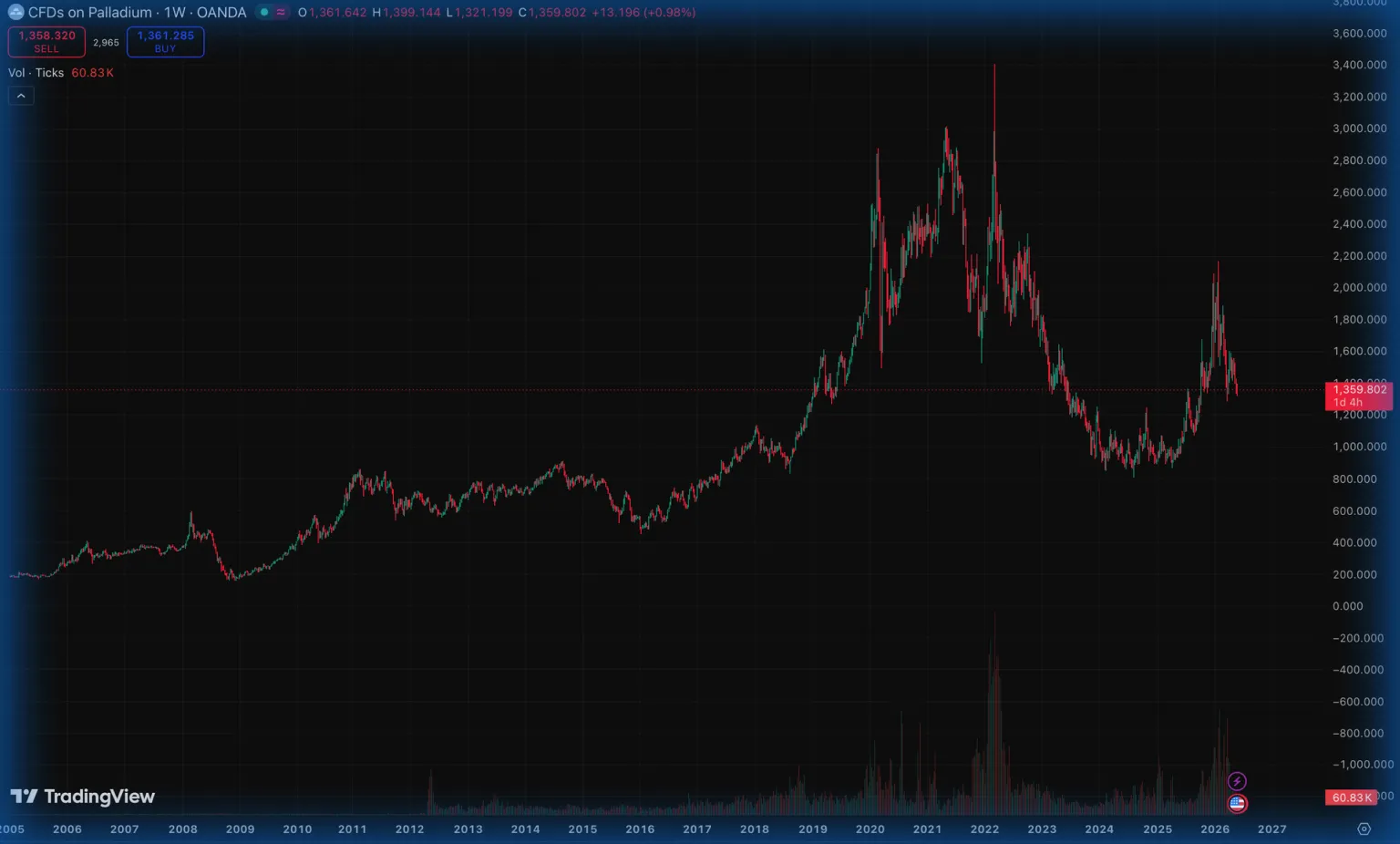
From 2012 through the early 2020s, the palladium market was marked by deficit.
Consumption consistently surpassed palladium mining output and secondary recycling.
This imbalance in supply and demand was caused due to the needs of the automotive industry throughout the 2010s while producers in Russia and South Africa were struggling with logistics.
The peak of the bullish trend happened following Russia’s invasion of Ukraine in 2022. The price of palladium skyrocketed above $3,400 an ounce.
The war caused a total frenzy. Companies were hoarding palladium bullion to protect their capital and the metal’s prices kept rising up.
However, as time went on, the automakers engineered solutions to deal with the high prices. Palladium was substituted by less expensive platinum wherever possible.
As a result, there were no reasons for prices to soar any longer. By 2025, the palladium market crashed. Prices collapsed toward $800 an ounce.
In 2026, however, the market displayed signs of a fast recovery. Prices have broken out the $2,000 an ounce mark in early February.
With all this history, a lot of investors wonder if palladium could be a wise investment option. Industrial demand could easily drive prices to an explosive rally again and the metal has a solid reason to become even more important with new technologies, right?
Forecasts are heavily divided at this point. Some analysts say palladium may soar again if hydrogen tech commercializes rapidly. But pessimists warn that exposure to palladium can be a bad idea if secondary recycled supply flood the market.
Uncertainty is the only guarantee we have at this point.
What Drives Demand in the Physical Palladium Market and Palladium Mining?
As previously said, Russia and South Africa are the world’s major players on the supply side. It is believed that together they are responsible for about 80% of worldwide palladium production.
Since 2022, the metal’s prices have been specially volatile due to geopolitical tensions.
Not only the wars, but also recent U.S. tariffs aggressively targeting Russian exports have been severely affecting palladium supply.
On the other hand, South Africa has many issues with infrastructure, which only make things harder.
Underground mining operations are constantly dealing with energy crisis that restrict how much producers of palladium can extract daily.
With all of these factors in mind, palladium offers a good upside for contrarian speculators.
Another factor is that the market is anticipating a massive influx of recycled material, which could be an additional challenge.
The Cons of Investing in Palladium in 2026
By far, the automotive sector is the one using palladium en masse.
Although hybrid vehicles don’t necessarily represent a threat to palladium demand, fully electric vehicles are another story.
Electric cars don’t have tailpipes, so they completely eliminate the need for exhaust filters.
Every single car that is 100% battery-powered destroys several grams of demand.
This is the largest con of investing in palladium right now.
The same green mandates that caused palladium demand to soar in the 2010s can make it drop rapidly. This is a huge problem for long-term holders.
In 2026, hybrid vehicles are the main factor still favoring buying palladium stocks or ETFs. As consumers shift from conventional cars to hybrids, the lifecycle of palladium consumption is extended. But if the trend in the long-term is to shift from hybrid to fully electric, then that paints a challenging picture for palladium holders.
Should You Invest in Gold or Platinum Instead of Palladium? Analyzing Investment Options
Overall, gold and silver investments act as a safe haven. When markets become too volatile and the uncertainty spikes around the world, investors shift to precious metal investments to protect their capital and avoid danger.
Platinum and palladium have a different behavior. These metals act as industrial commodities, so they’re heavily dependent on factory demand.
If you compare palladium vs gold or silver prices, you’ll notice how price action differs. Palladium is much more volatile than gold or silver.
In other words, investing in palladium increases drawdown risks. You’ll be much more exposed to geopolitical shocks and industrial demand.
When it comes to platinum, experts expect a long-term supply deficit. It is also more malleable and easier to work with than palladium, being used in diesel engines, the global jewelry market, and also in hydrogen tech.
Many experts would recommend trading palladium for platinum for your investment goals.
Comparing Palladium Investment Options: From ETFs and Mutual Funds to Palladium Coin
If you want to invest in the metal regardless of its current challenges, there are many options available currently.
- If you prefer holding physical precious metals, you can buy palladium bullion coins or American palladium bars. However, it’s worth mentioning that this options involves heavy fees and taxes. You’d also need to have a safe place to store your bullion bars securely.
- If you prefer financial instruments, which is one of easiest ways to invest in palladium, you can look at exchange-traded funds and mutual funds to gain exposure to the metal. A great choice for this investment option involves buying Aberdeen physical palladium shares (PALL). Besides funds, you can also trade futures contracts to take advantage of volatility.
If you’re able to deal with the challenges of storing the physical metal, the answer is buying bars and coins. If you wish to take advantage of the benefits of financial instruments, ETFs are a good bet for long-term investments, whereas futures contracts offer the volatility for swing trading strategies mirroring specific types of stock trading strategies.
Conclusion
I’m not going to sugarcoat it, adding palladium as an investment is for experienced investors, who know very well what they’re doing and have the stomach to deal with increased uncertainty.
Although palladium holders lived through one of the most beautiful bull markets from 2012 to 2022, there is no guarantee the trend will continue. This market comes with several structural risks.
I would suggest watching out for the developments of the hydrogen tech sector, as that’s where the future of palladium seems to be.
Until this tech matures, prioritize continuous learning and risk management. Study the macroeconomics and be disciplined to your trading system.